
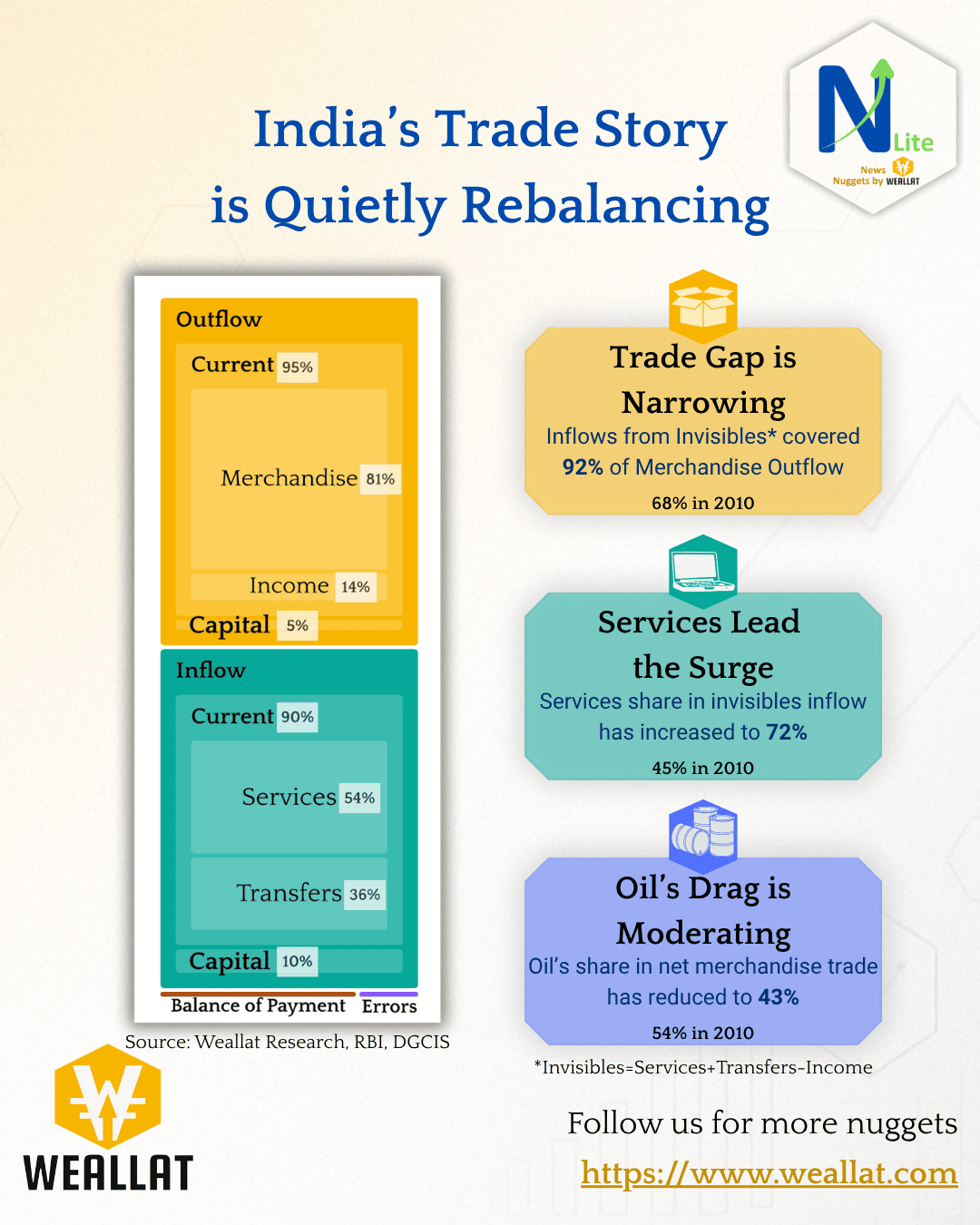
Over the last decade and a half, India’s Balance of Payments (BoP) has quietly undergone a shift — from dependence on physical exports and oil imports to strength through services and digital flows.
🔁 Trade Gap Nearly Closed
In 2010, inflows from invisibles (services, transfers, and income) covered only 68% of merchandise outflows. In 2025, this number stands at 92%, reflecting a dramatic strengthening in India’s external account.
💻 Services Drive Inflows
Services have become India’s economic powerhouse:
- Their share in invisible inflows rose from 45% to 72%
- Growth driven by software exports, IT services, consulting, digital infrastructure
This rise is structural — built on talent, global integration, and remote delivery.
🛢️ Declining Oil Dependency
In 2010, oil accounted for 54% of India’s merchandise trade deficit. In 2025, it's down to 43%.
This reflects:
- Energy diversification
- Renewable adoption
- Domestic production efforts and storage buildup
📈 The Takeaway India’s trade story is shifting:
- Less fragile, more flexible
- More service-led, less oil-intensive
- More digital, less dependent on global volatility
As investors and policymakers look to the future, India’s BoP signals a foundation of sustainability and self-reliance.
